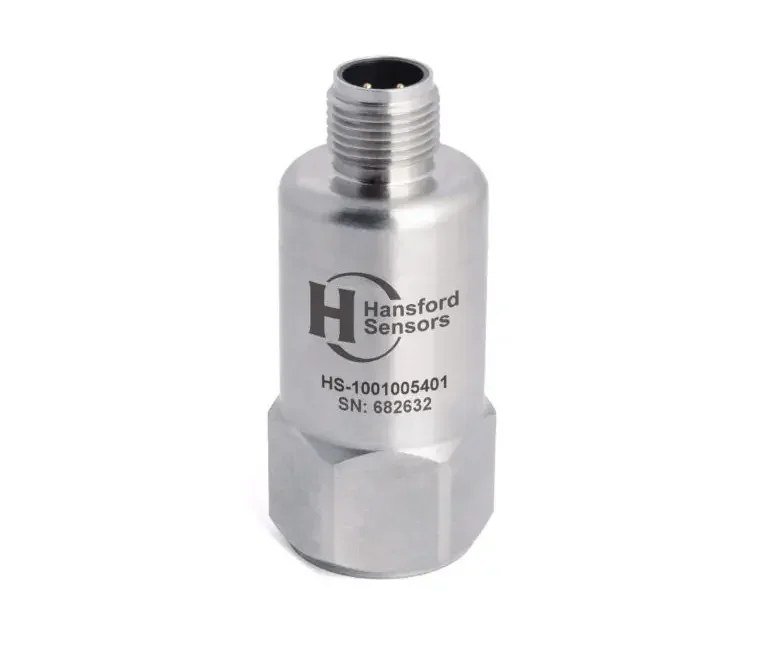
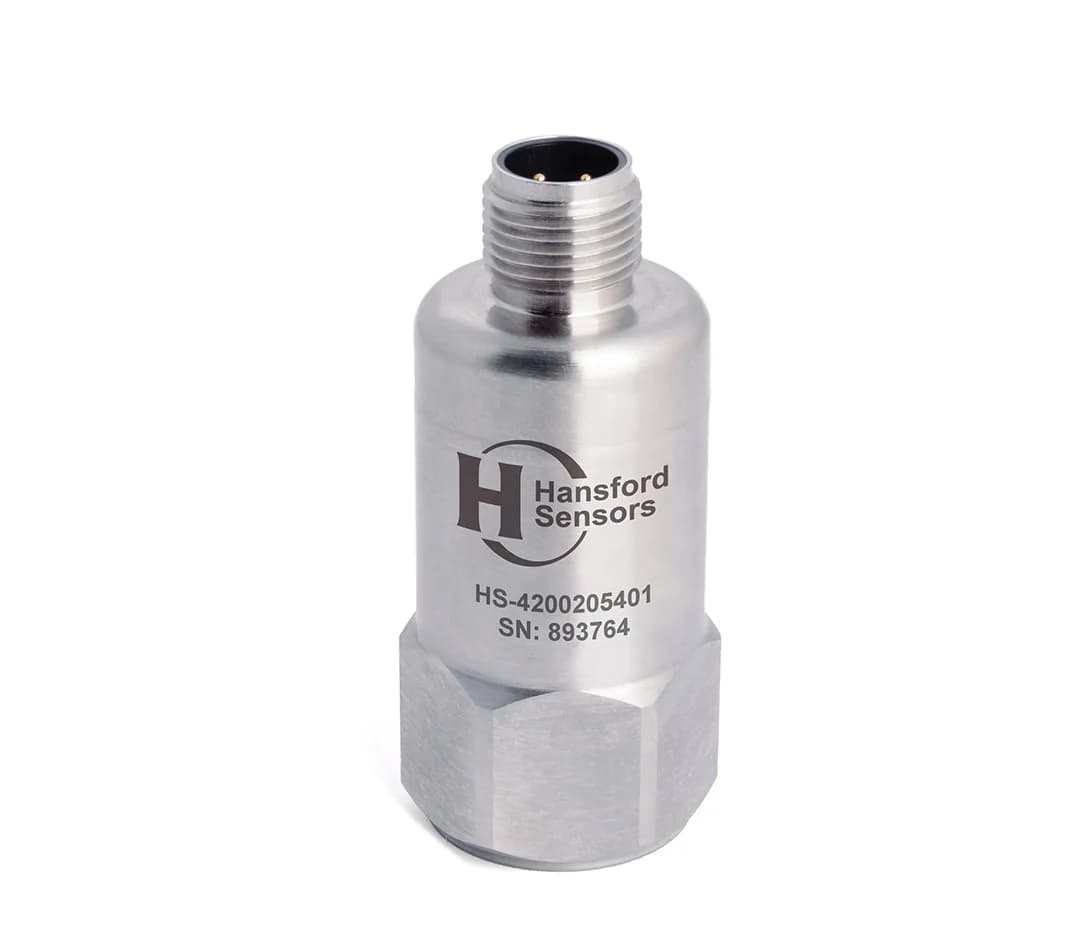
HS-100 Industrial AC accelerometer, top exit, M12 connector
- AC IEPE
- 10 … 500 mV/g
- Top exit
- IP67
PDF datasheet
Exclusive Hansford Sensors distributor for Poland, the Czech Republic and Slovakia
The availability of a generating unit depends not only on the turbine and generator but also on auxiliary equipment: cooling tower fans, cooling water pumps, and air and flue gas fans. Vibration monitoring of these machines helps avoid load reductions and forced outages.

A failure of a cooling tower fan or cooling water pump reduces heat removal, which can force a reduction in unit output and, in extreme cases, a unit shutdown. Damage to such machines rarely appears suddenly: rotor unbalance, drive shaft misalignment and gearbox bearing wear develop gradually and are clearly visible in vibration measurements. Condition monitoring of auxiliary machines therefore makes it possible to schedule repairs for a convenient time.
A cooling tower fan operates in an extremely humid environment: the gearbox is usually in the stream of saturated air, while the motor is outside the diffuser, connected to the gearbox by a long drive shaft. A damaged blade or an unbalanced rotor can cause excessive vibration and damage to the structure. In practice, the gearbox can only be reached after the fan has been shut down, which is why sensors are mounted there permanently.
Elsewhere in the power station, sensors are exposed to moisture, dust, high temperatures near the boiler and interference from high-power drives. Signals usually go to the unit DCS, and diagnostic measurements are taken periodically with a data collector.
01Machines in this industry
Cooling tower fans, right-angle gearboxes of cooling tower fans, fan and auxiliary drive motors and others — measuring point on the bearing housing.
02Sensor
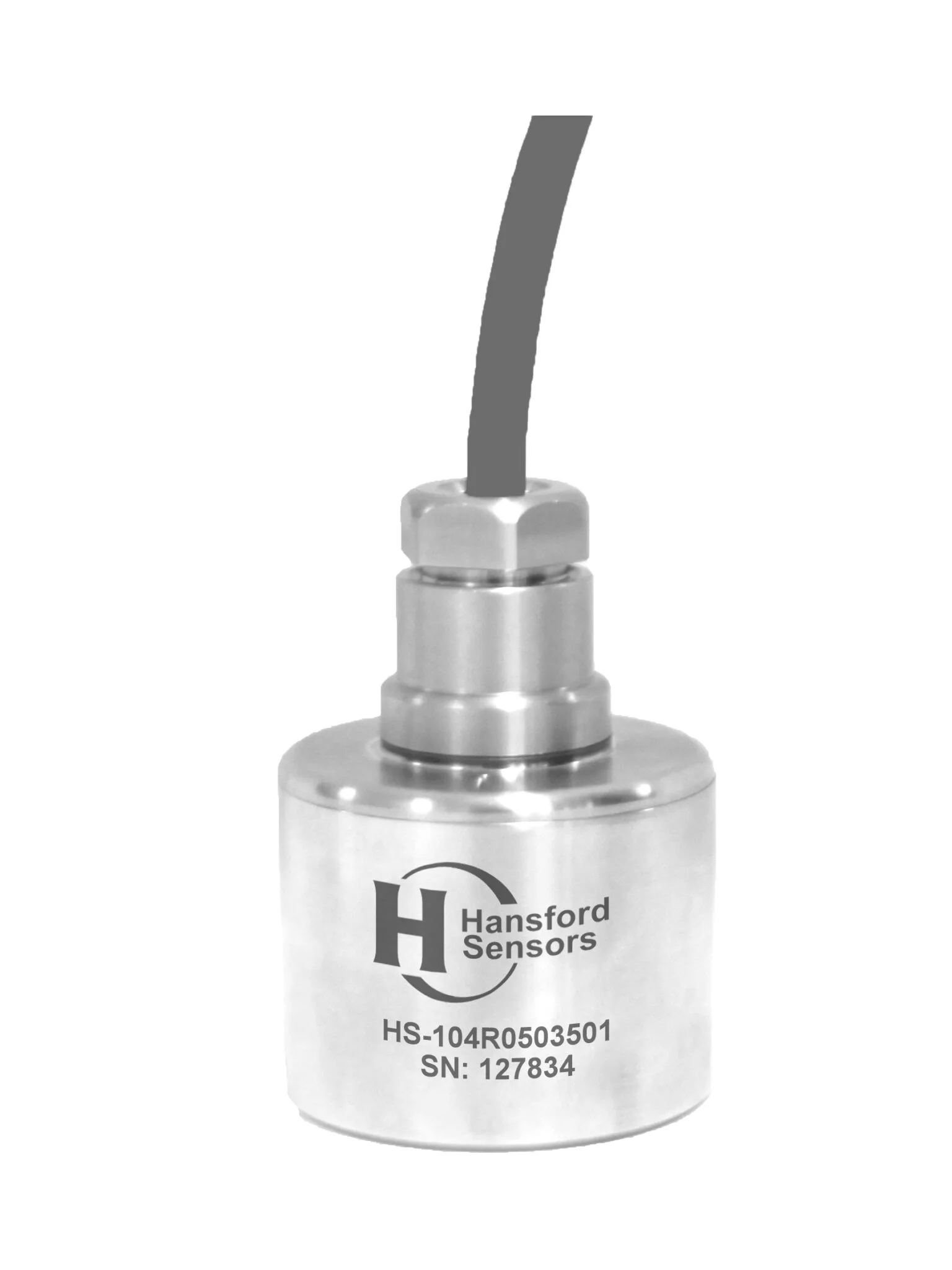
An IEPE accelerometer or a 4–20 mA sensor converts vibration (and often temperature) into an electrical signal.
Industrial IEPE accelerometers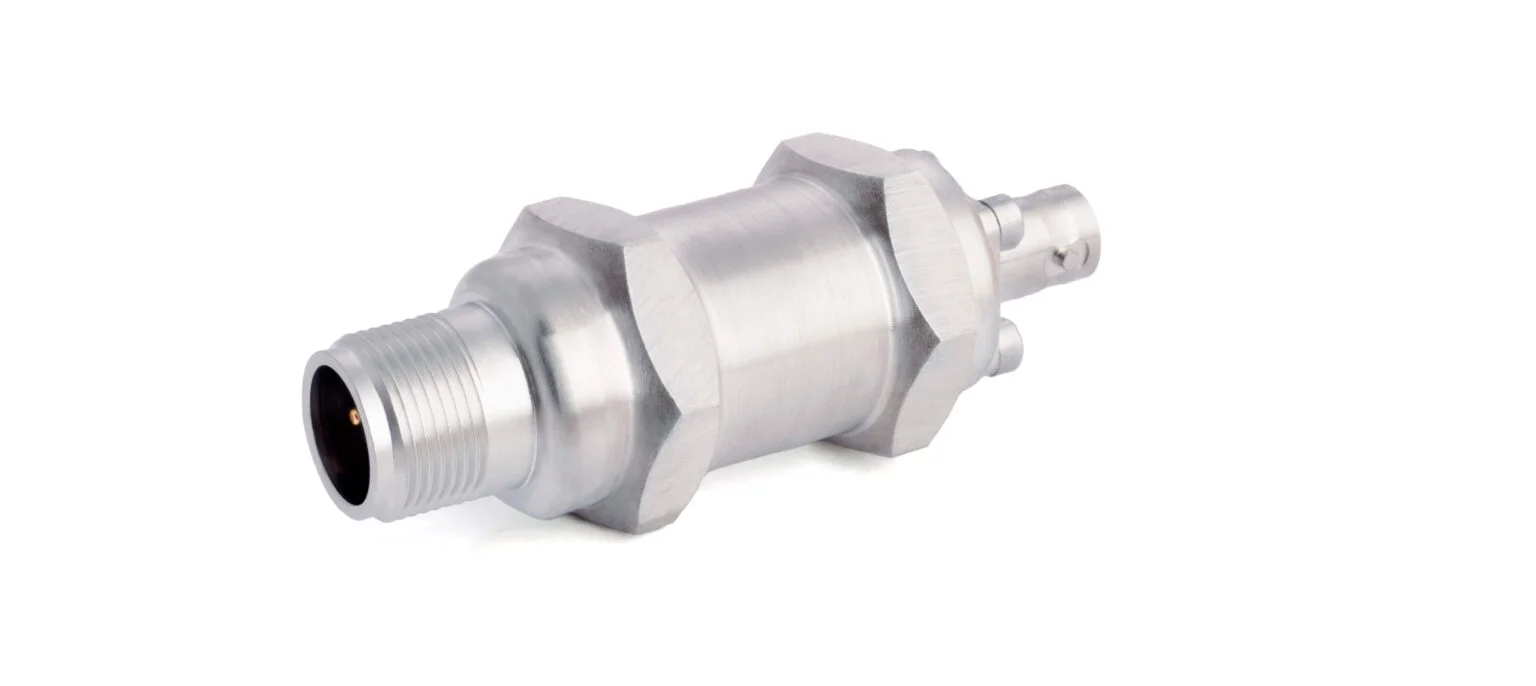
03Signal
A cable with the right connector and a junction box carry the signal from many measuring points to the system.
Cables and connectors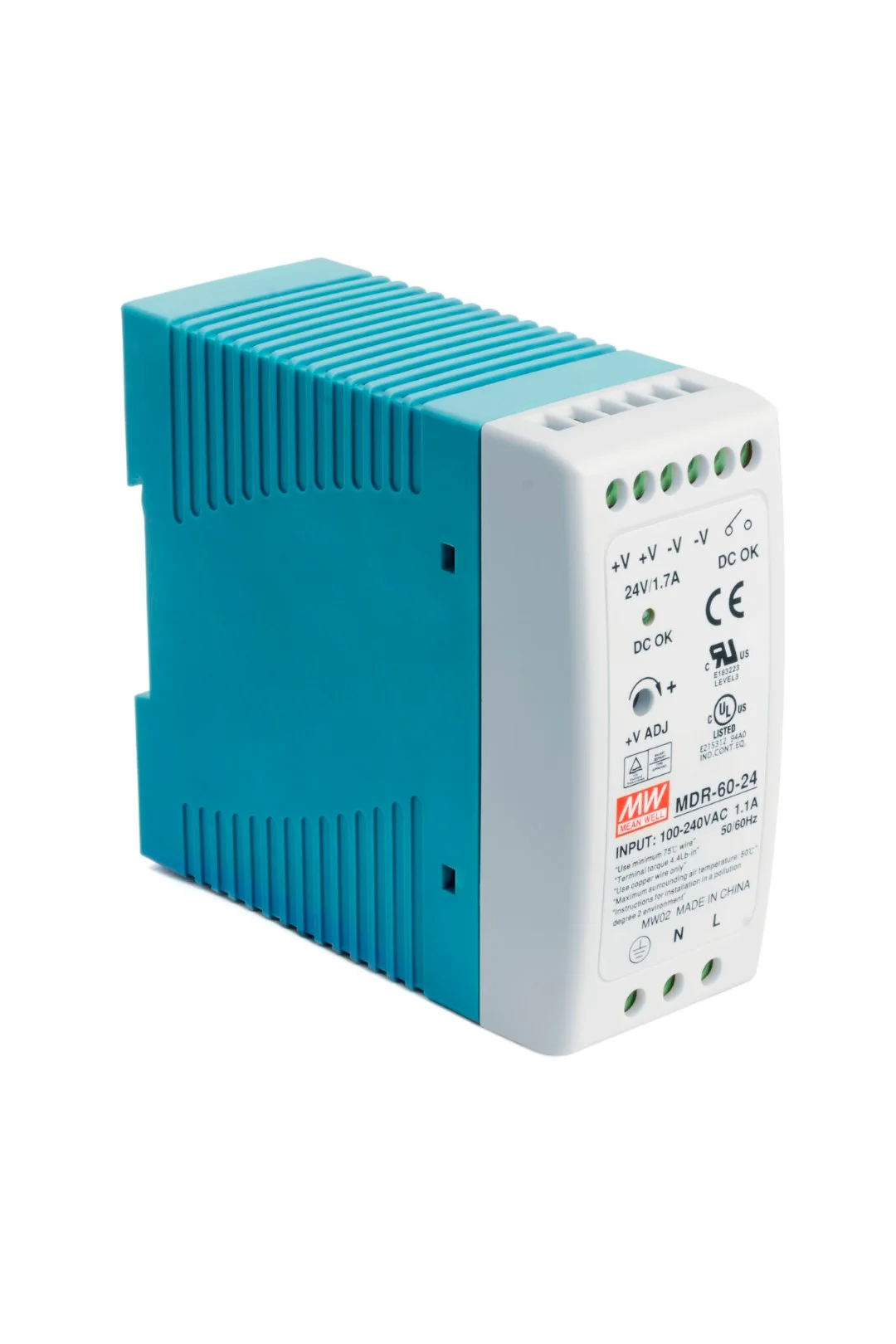
04Monitoring
PLC, DCS, an online system or a data collector: trends, alarm thresholds and diagnostics before a failure happens.
Vibration systems and switchesSealed HS-100 accelerometers with a standard sensitivity of 100 mV/g are mounted on the fan gearbox, and their cables are routed outside the diffuser to a waterproof HS-JE junction box or an HS-SE switch box. Diagnostic measurements with a data collector — including gear mesh and bearing analysis — can then be taken without entering the cooling tower.
HS-420 sends a 4–20 mA signal proportional to vibration velocity to the unit PLC or DCS. The machine condition criteria in the ISO 20816 series of standards are usually expressed in vibration velocity, which makes it easier to set warning and alarm thresholds for fans, pumps and motors — see 4–20 mA vibration sensors.
On the many pumps, fans and motors that do not need continuous monitoring, permanently mounted HS-100 accelerometers wired to switch boxes form a measurement route for the data collector. Data collected regularly from the same points makes it possible to detect changes early.
Cable routes in a power station can be long and run outdoors. Choose cables suitable for damp and outdoor conditions (the datasheet gives their properties), route them away from power cables and make connections in sealed enclosures — see cables and connectors.
PDF datasheet
Accelerometer for cooling tower fans, gearboxes and motors.
PDF datasheet
4–20 mA sensor for continuous monitoring in power plant PLC and DCS systems.
The main points are the gearbox housing at the input and output shaft bearings, and the motor bearings outside the diffuser. Mount the sensors on studs, in the radial direction, on rigid parts of the housing rather than on thin covers. With a long intermediate shaft, measurements at both ends of the shaft help to detect misalignment.
The signal can be used in PLC or DCS logic for alarm and shutdown. However, the thresholds, time delays and the way limit exceedances are confirmed are set by the plant, so that transient conditions such as start-up do not cause false trips. Modules and vibration switches from the vibration systems and switches category can also be used for local machine protection.
If the aim is a trend and an alarm in the unit control system, a 4–20 mA transmitter such as the HS-420 is enough. Identifying cavitation, bearing damage or looseness requires an AC signal and spectrum analysis. That is why critical pumps use an accelerometer such as the HS-100, or a sensor with both outputs.
Describe the cooling tower, pumps or fans you want to monitor and the system the signal should go to. We will help you select sensors, cables and reading points.