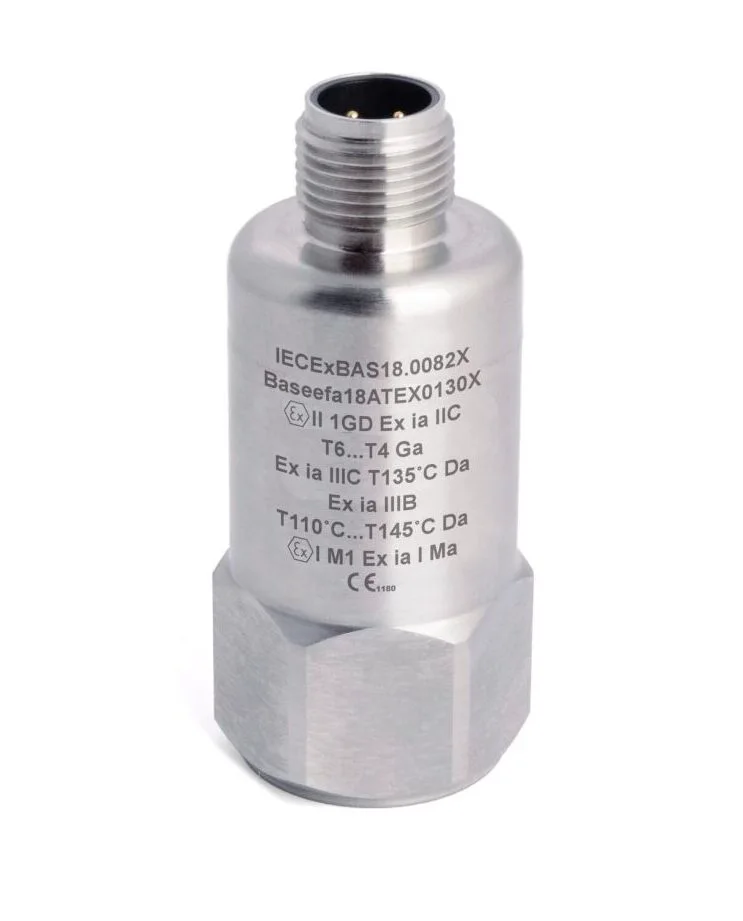
HS-100I Intrinsically safe accelerometer, top exit, M12 connector
Output: AC 100 mV/g (acceleration), M12 connector.
- AC IEPE
- 10 … 100 mV/g
- Top exit
- IP67
PDF datasheet
Exclusive Hansford Sensors distributor for Poland, the Czech Republic and Slovakia
Vibration sensors
Vibration sensors are the basis of diagnostics and monitoring of rotating machinery — motors, pumps, fans, compressors and gearboxes. The catalogue includes industrial accelerometers with AC (IEPE) output for vibration analysis, 4–20 mA vibration transmitters that connect directly to PLC, DCS and SCADA systems, and versions for Ex zones, high temperatures and battery-powered devices.
Output: AC 100 mV/g (acceleration), M12 connector.
PDF datasheet
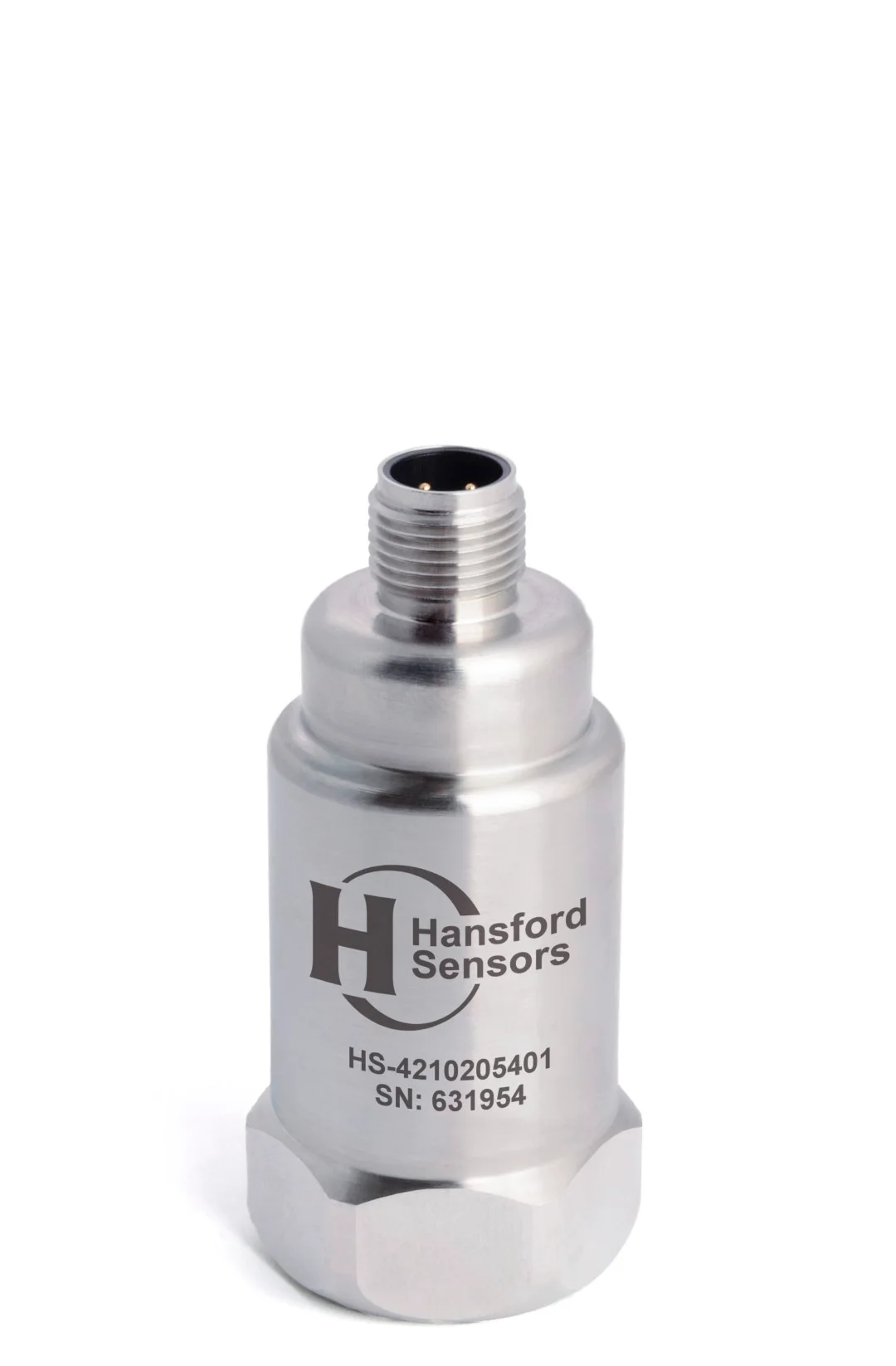
Outputs: 4–20 mA (vibration velocity) and AC (acceleration), M12 connector.
PDF datasheet
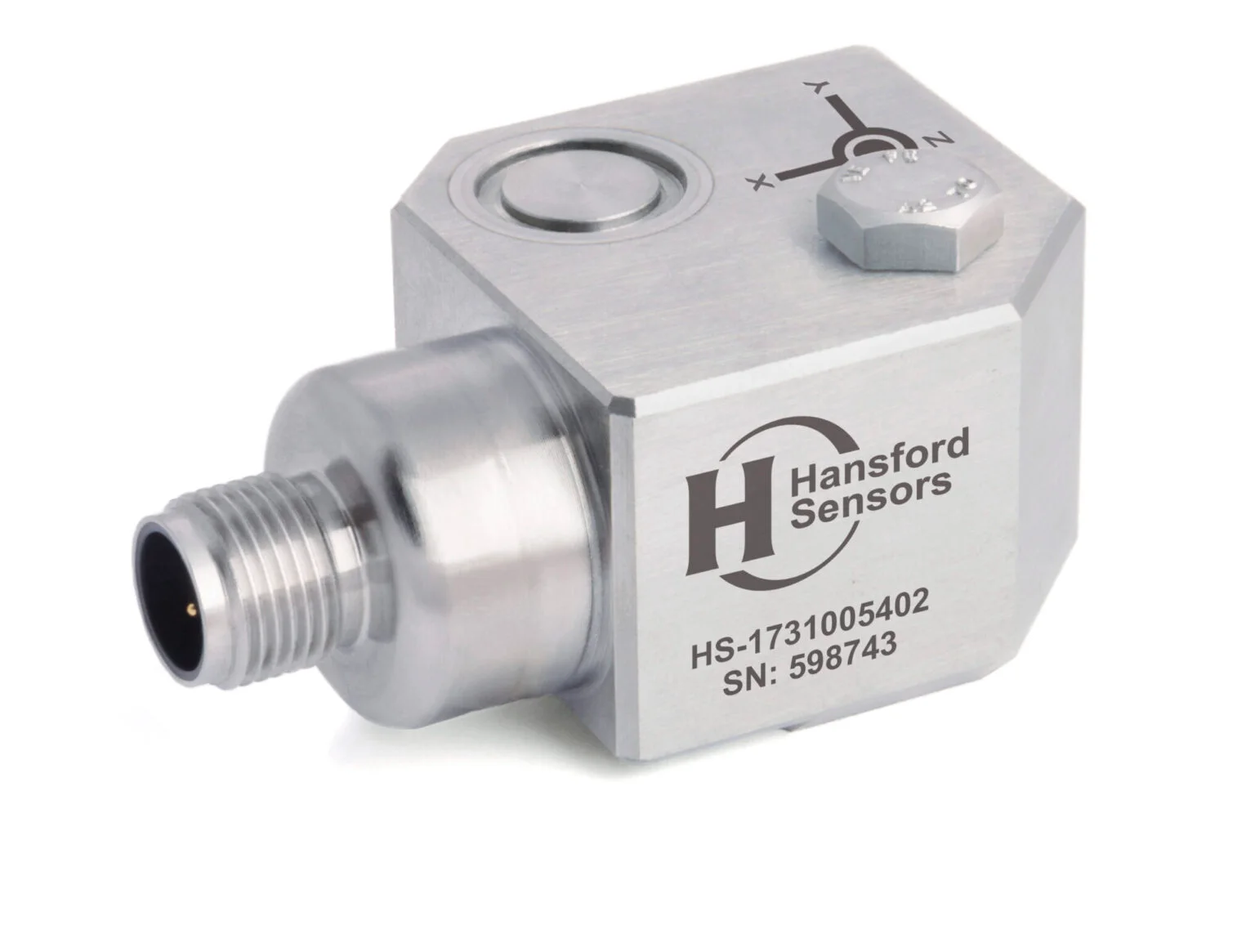
Output: 3 × AC 100 mV/g (acceleration), M12 connector.
PDF datasheet
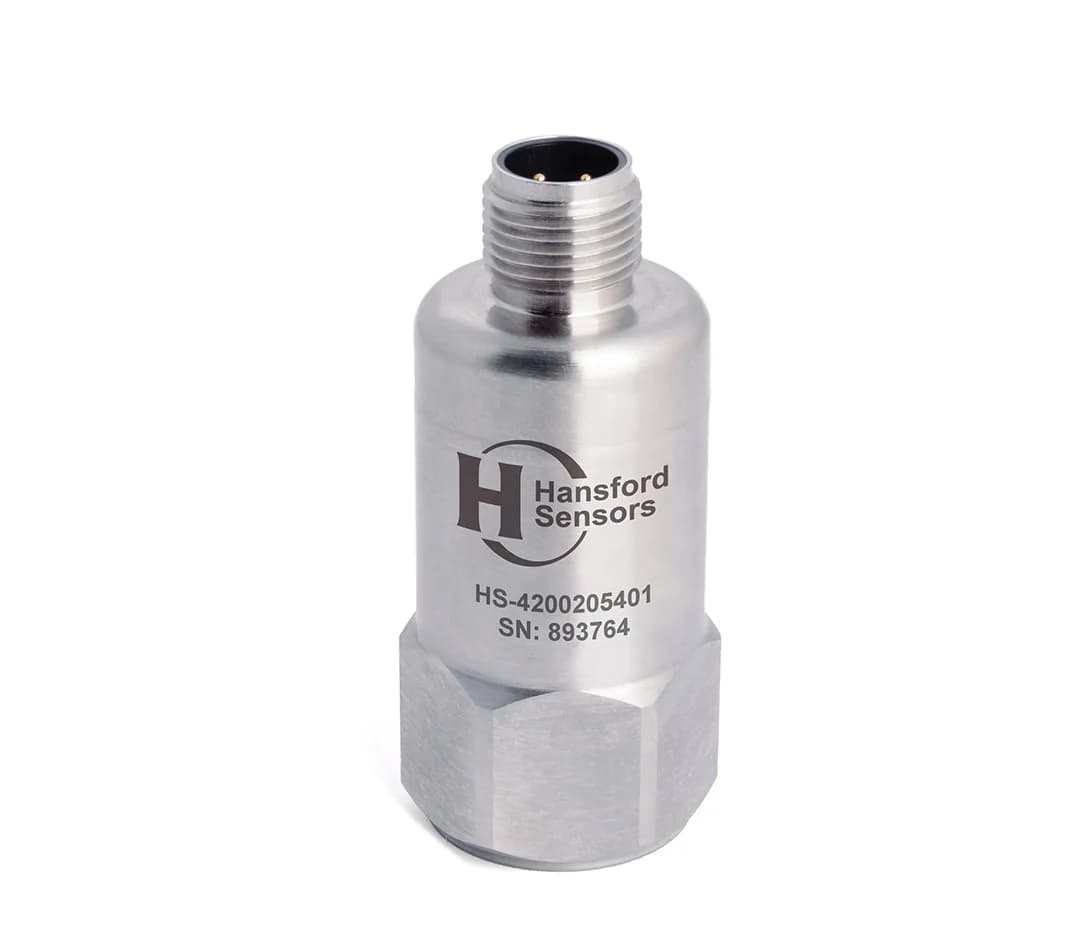
Output: 4–20 mA (vibration velocity), M12 connector.
PDF datasheet
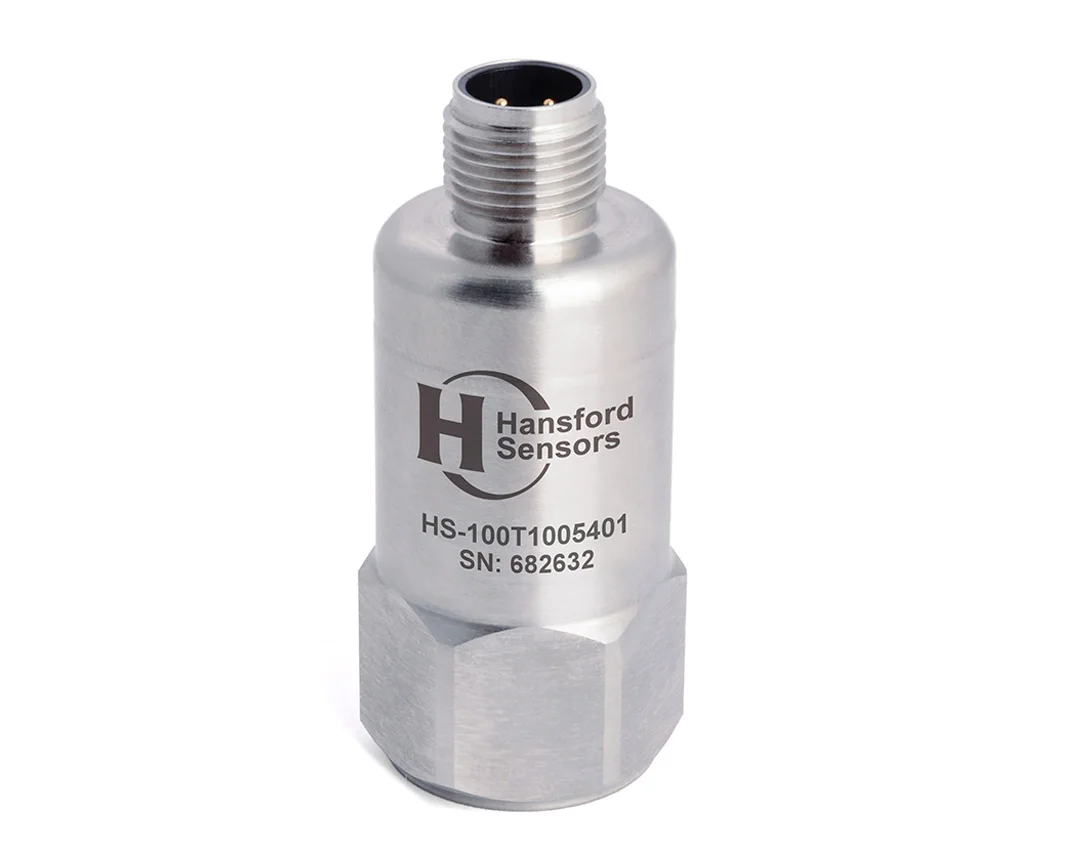
Outputs: AC 100 mV/g (acceleration) and 10 mV/°C (temperature), M12 connector.
PDF datasheet
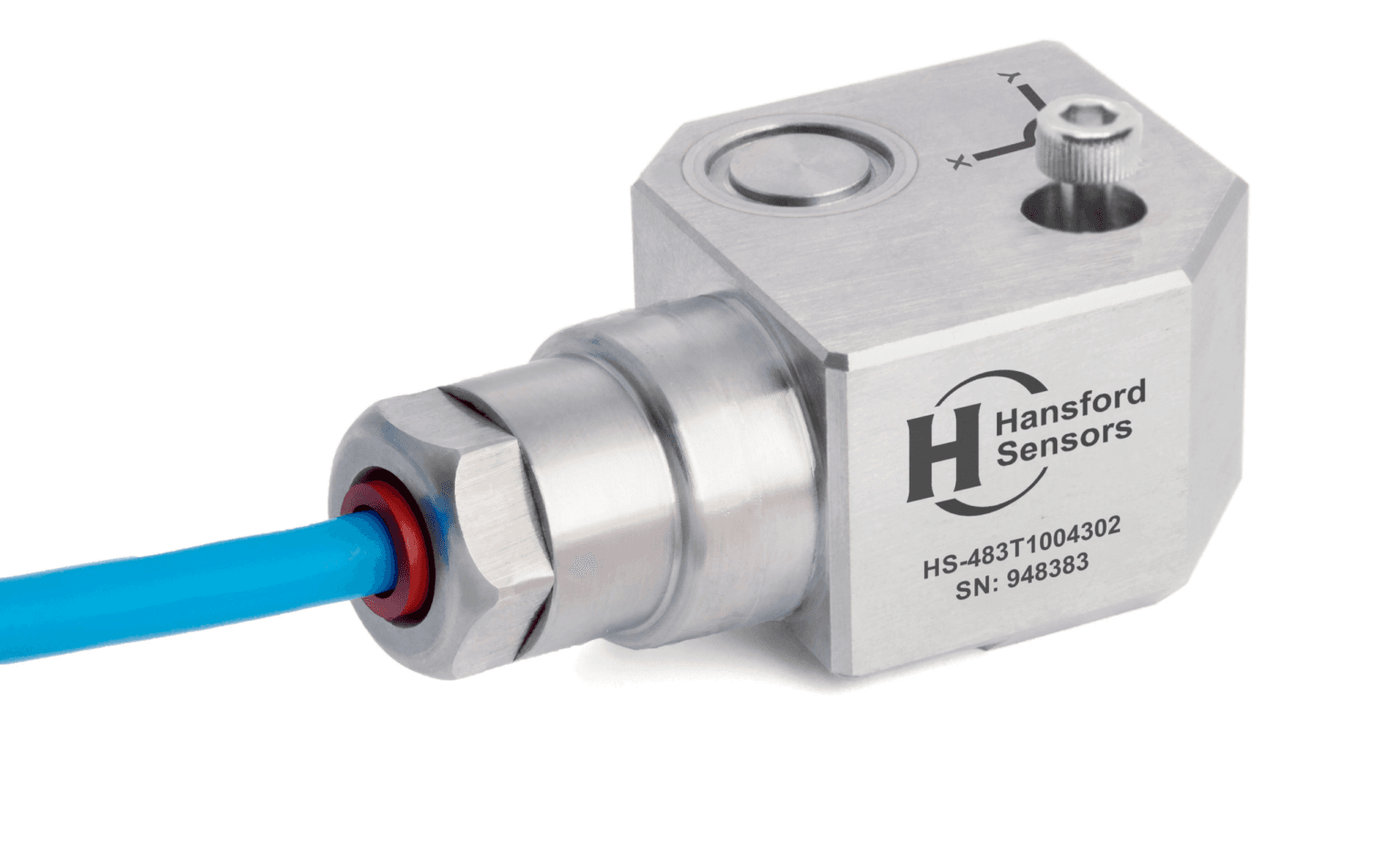
Outputs: 4–20 mA (vibration acceleration) and temperature signal, 8-core PUR cable.
PDF datasheet
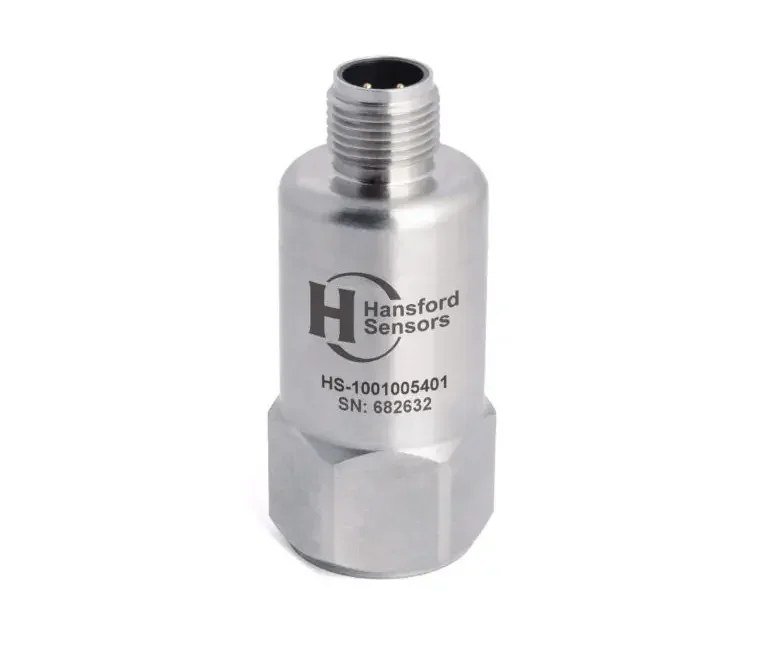
Output: AC 100 mV/g (acceleration), M12 connector.
PDF datasheet
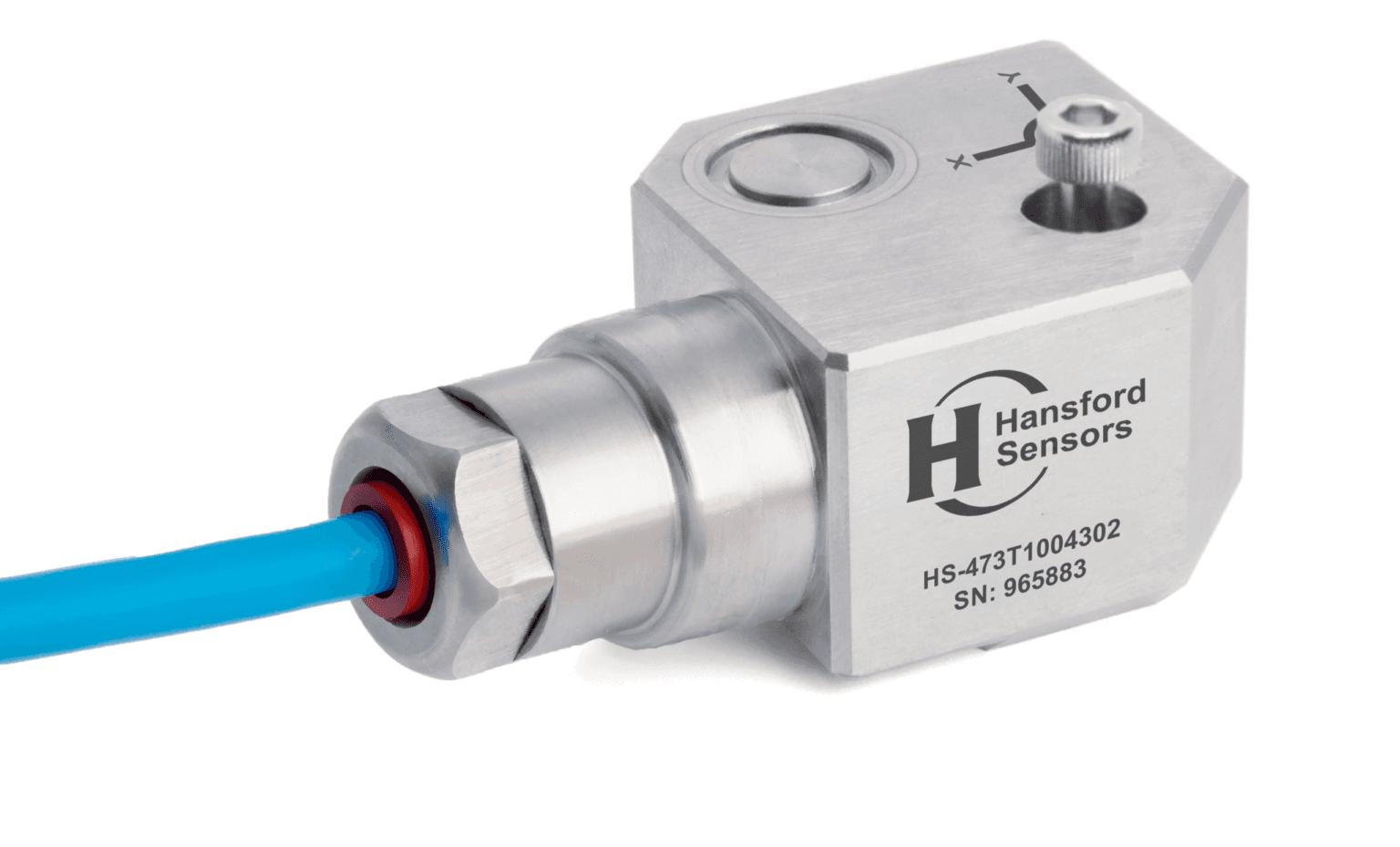
Outputs: 4–20 mA (vibration velocity) and temperature signal, 8-core PUR cable.
PDF datasheet
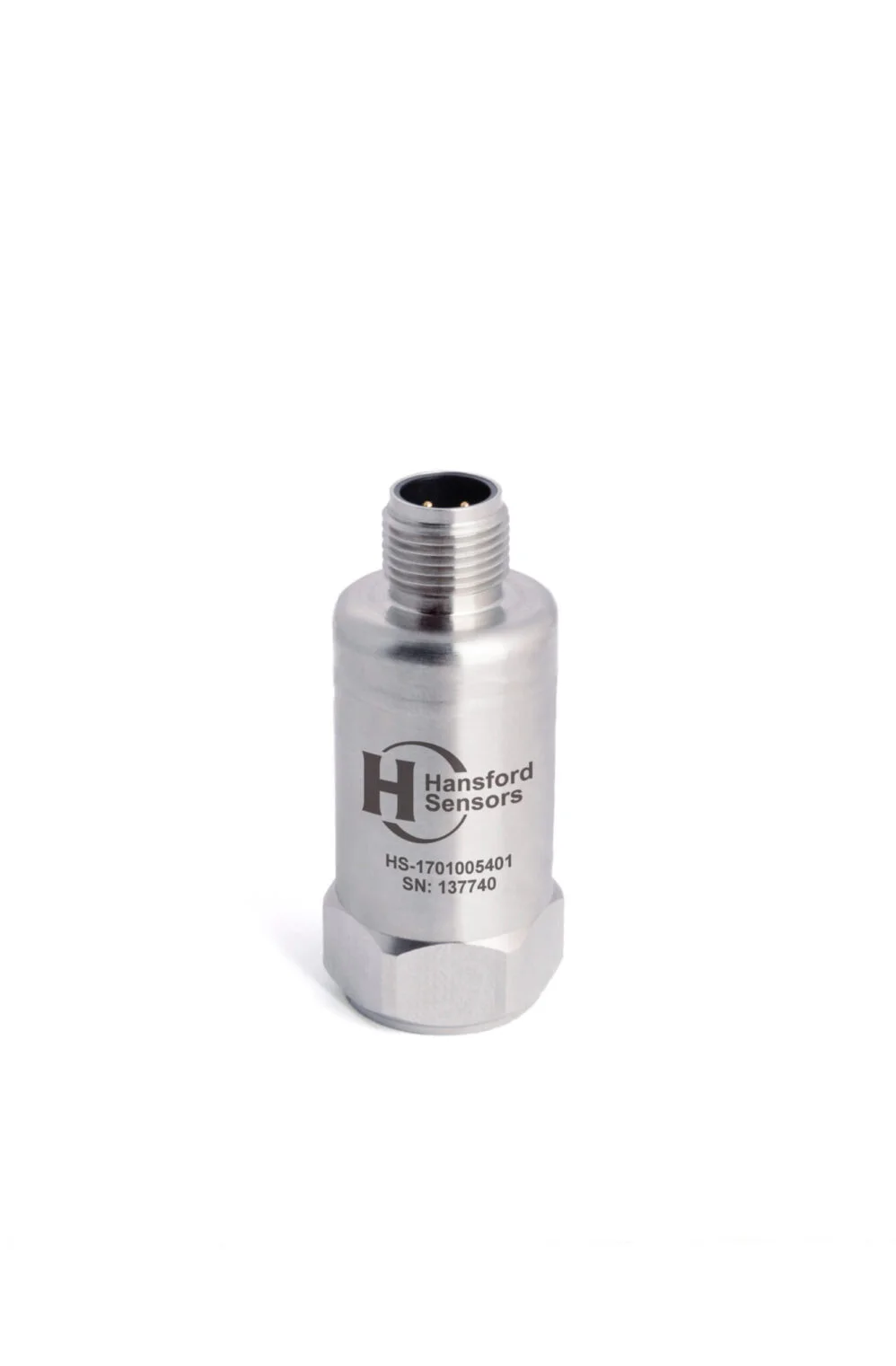
Output: AC 100 mV/g (acceleration), M12 connector.
PDF datasheet
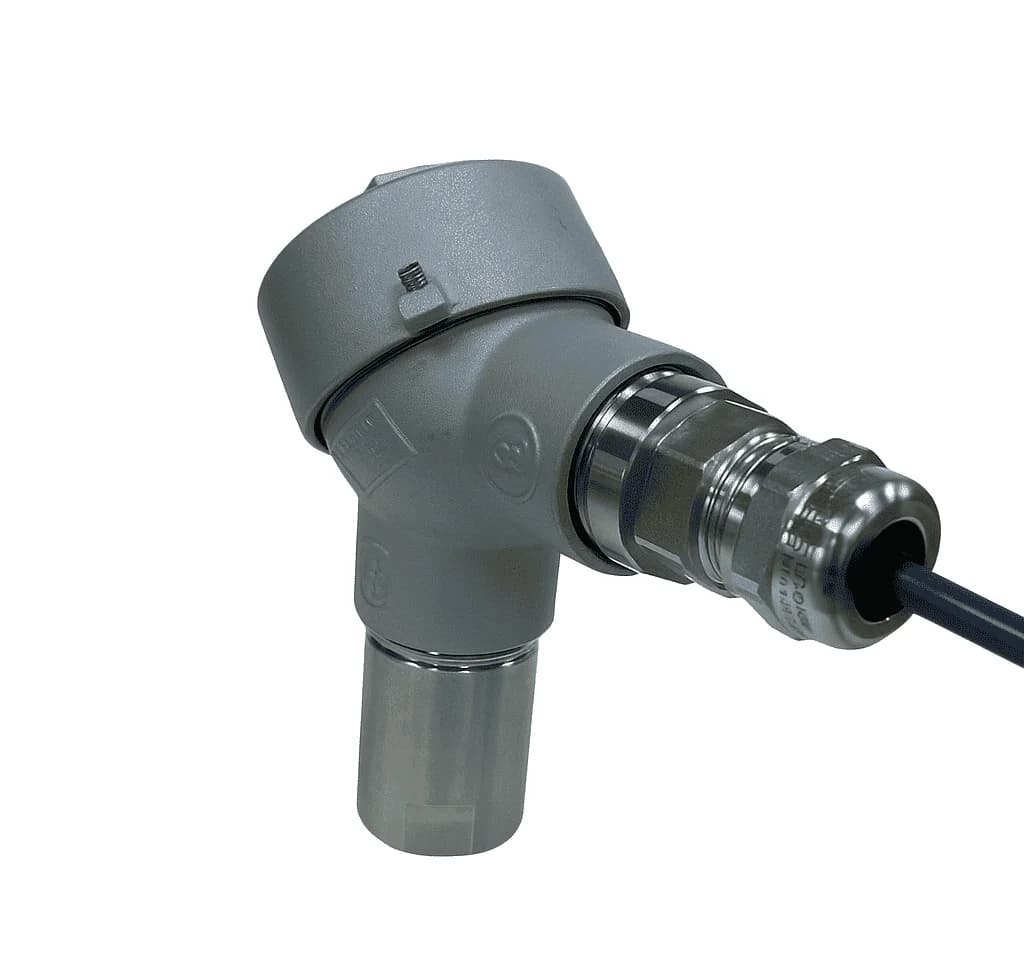
Output: 4–20 mA (vibration velocity).
PDF datasheet
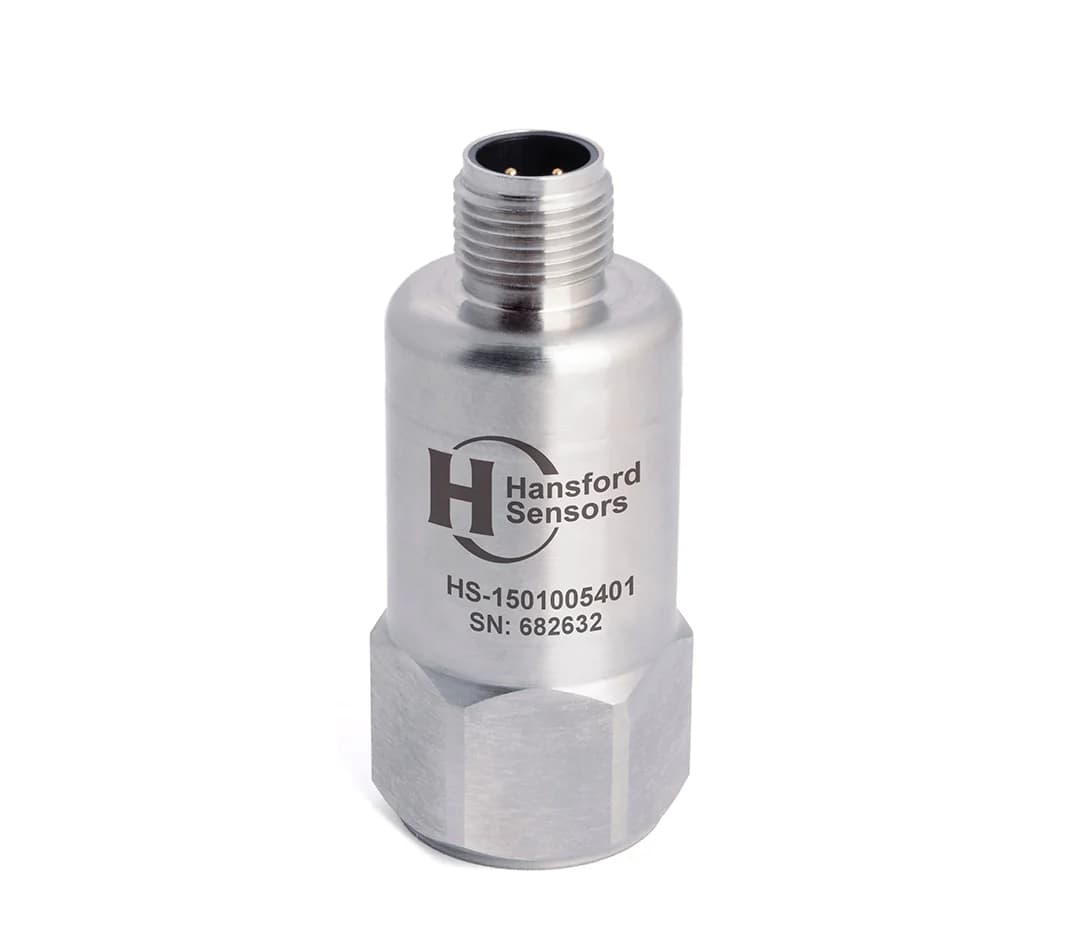
Output: AC 100 mV/g (acceleration), M12 connector.
PDF datasheet
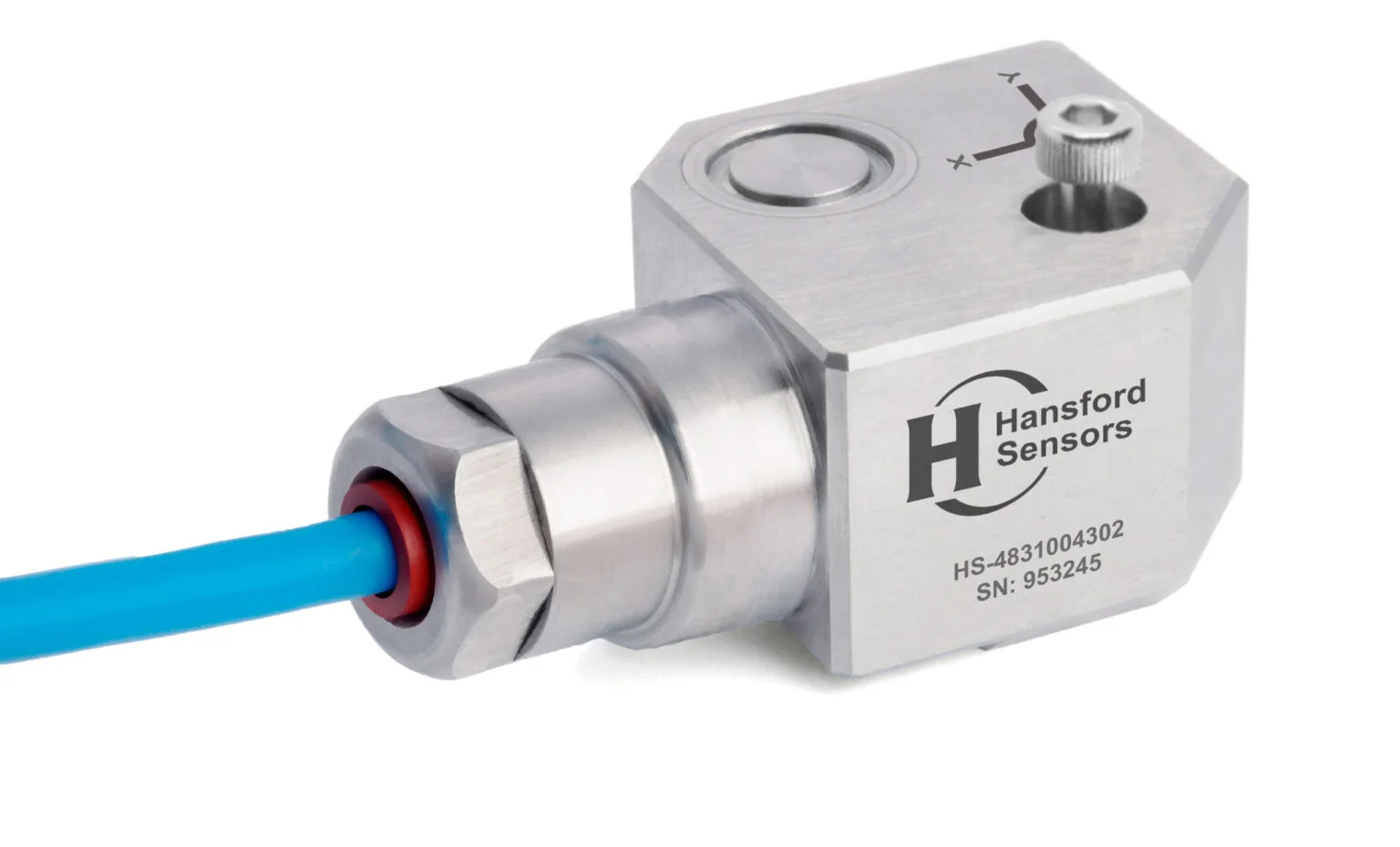
Output: 4–20 mA (acceleration), 8-core PUR cable.
PDF datasheet
IEPE accelerometers provide a dynamic voltage signal proportional to acceleration — 100 mV/g as standard, over a frequency range of 0.8 Hz – 15 kHz (±3 dB). This is the signal for portable data collectors, analysers and online monitoring systems, from which the spectrum, envelope and overall values are calculated. The Standard line includes sensors with a piezoelectric element working in compression, e.g. HS-100, and the Premium line — shear designs, e.g. HS-150 and HS-170.
Loop-powered sensors convert vibration into a single overall value and output it as a 4–20 mA signal that goes directly to the controller’s analogue input. You can choose versions proportional to vibration velocity (HS-420) or to acceleration (HS-422), as well as versions with an additional AC output for analysis (HS-421).
Velocity output sensors provide an AC signal proportional to vibration velocity — for instruments and systems that expect this type of signal.
Biaxial and triaxial accelerometers, e.g. HS-172 and HS-173, measure vibration in several directions from a single mounting point. Triaxial versions are also available with a 4–20 mA output.
Intrinsically safe versions of accelerometers and 4–20 mA transmitters have the letter “I” in the model designation, e.g. HS-100I or HS-420I/M. For an overview of explosion-protected versions, see the ATEX vibration sensors page.
High-temperature accelerometers work with an external charge amplifier, so the electronics stay outside the high-temperature zone — the HS-105 operates at up to 250 °C.
Low Power accelerometers, e.g. HS-104, are designed for battery-powered devices and wireless monitoring systems.
Sensors with an additional temperature output (10 mV/°C or PT100) measure vibration and bearing housing temperature at a single point — for more, see the vibration and temperature sensors page.
The catalogue also includes accelerometers with a Line Drive current output and OEM capsules for building into your own equipment.
Categories correspond to signal types and applications. On a category page you can narrow down the list with filters — for example by output type, sensitivity, cable exit direction, connector, cable type, IP rating, number of axes, Ex version and operating temperature.
Models usually come in several connection versions — with an M12 or MS connector, or with an integral PUR, FR, HFFR, FEP or braided cable — and many of them also in a side-exit variant marked with the letter “S” (e.g. HS-100S). Some parameters, such as sensitivity, mounting thread or cable length, are selected when ordering; the available options are given on the product page and in the datasheet. You can compare selected models side by side in the product comparison.
First, establish where the signal will go. If it goes to a data collector or an online system, choose an IEPE accelerometer. If it goes to a PLC, DCS or SCADA system, choose a 4–20 mA transmitter. Then define the conditions at the mounting point: temperature, moisture and washdown, oils, dust, a possible Ex zone, and the space available above the measuring point. The guide How to choose a vibration sensor for your machine describes the procedure in detail, and the sensor selector narrows down the choice after a few questions.
A sensor usually needs mounting hardware — studs, adhesive mounting pads or magnetic mounts — and cables and connectors. With many measuring points, the signals are collected in industrial enclosures, i.e. connection boxes and switch boxes, and then processed in modules and systems. You can add all of these items to a single quote request.
For most rotating machines, 100 mV/g is the standard. A lower sensitivity (e.g. 10, 30 or 50 mV/g) is chosen for high levels of vibration and shock, so that the signal does not exceed the range of the measurement chain. A higher sensitivity (250 or 500 mV/g) is chosen for very low vibration, e.g. on low-speed machines. The datasheet gives the sensitivities available for a given model.
In both designs, the sensing element is PZT piezoceramic. The compression design, used in the Standard line (e.g. HS-100), is a proven general-purpose solution. The shear design, used in the Premium line (e.g. HS-150 and HS-170), provides a shorter signal settling time and greater measurement stability.
For many models, yes. Sensitivity, mounting thread and cable length are options chosen when ordering, and for 4–20 mA transmitters, so is the measuring range. The available variants are given on the product page and in the datasheet. Enter the options you need in your quote request.
Often, yes, if the following match: signal and power supply type, sensitivity or measuring range, frequency range, connector or cable, mounting thread and dimensions — and, in Ex zones, also certification and circuit parameters. Send us the designation of your current sensor and a description of the measurement chain using the contact form, and we will help you find an equivalent.
Send a list of models or describe the machine and the operating conditions — we will choose the right version and prepare a quotation.